


Completing the Dallas County Promise Path Form can be a great way to begin thinking about your college future and access resources to help you on your college journey. High school students should consider filling out the Path Form and taking advantage of these opportunities, whether you’re sure where you want to go to college or still deciding.
You Do Not Need to Have Everything Figured Out
If you’re a high school student who isn’t sure what your plans are when finishing high school, you aren’t alone. A recent YouScience report found that nearly 72% of high school students feel somewhat or entirely unprepared for life after high school. Whether you’re interested in college but unsure, want career training, want to enter the workforce right away, or don’t even know what your options are, completing the Dallas County Promise Path Form can help point you in a right direction.
What Is the Dallas County Promise Path Form?
The Dallas County Promise Path Form is a short series of identification questions and a place to share basic information about your interests and possible plans after high school graduation. Students can indicate their current plans, including a two- or four-year college program, a workforce or certification program, joining the military, or other options. Even if students aren’t sure yet what they want to commit to, they should still complete the form.
While the Path Form is the first step toward a possible Dallas County Promise scholarship, it isn’t an application for college, financial aid, or an agreement to attend any particular school. Instead, think of the Path Form as a non-committal means of getting resources to help you better understand your future options.
Why Is It Important?
The Dallas County Promise Path Form is a mandatory step toward high school seniors earning the Dallas County Promise last-dollar grant, acknowledging your interest in the program, and providing you with your Promise ID, which you’ll use to manage your college application and financial aid process. However, completing your Path Form at any point during high school also offers various other benefits, including:
- Gives you a reason to start thinking about life after high school in a stress-free, non-committal way.
- Helps connect students with information based on existing goals and college aspirations.
- Allows Dallas County Promise to stay in contact and provide updates on follow-up steps and reminders for critical deadlines.
- Helps introduce students and their families to numerous resources on colleges, financial aid programs, career opportunities, and steps to join the workforce.
What Does the Path Form Mean for Each Grade Level?
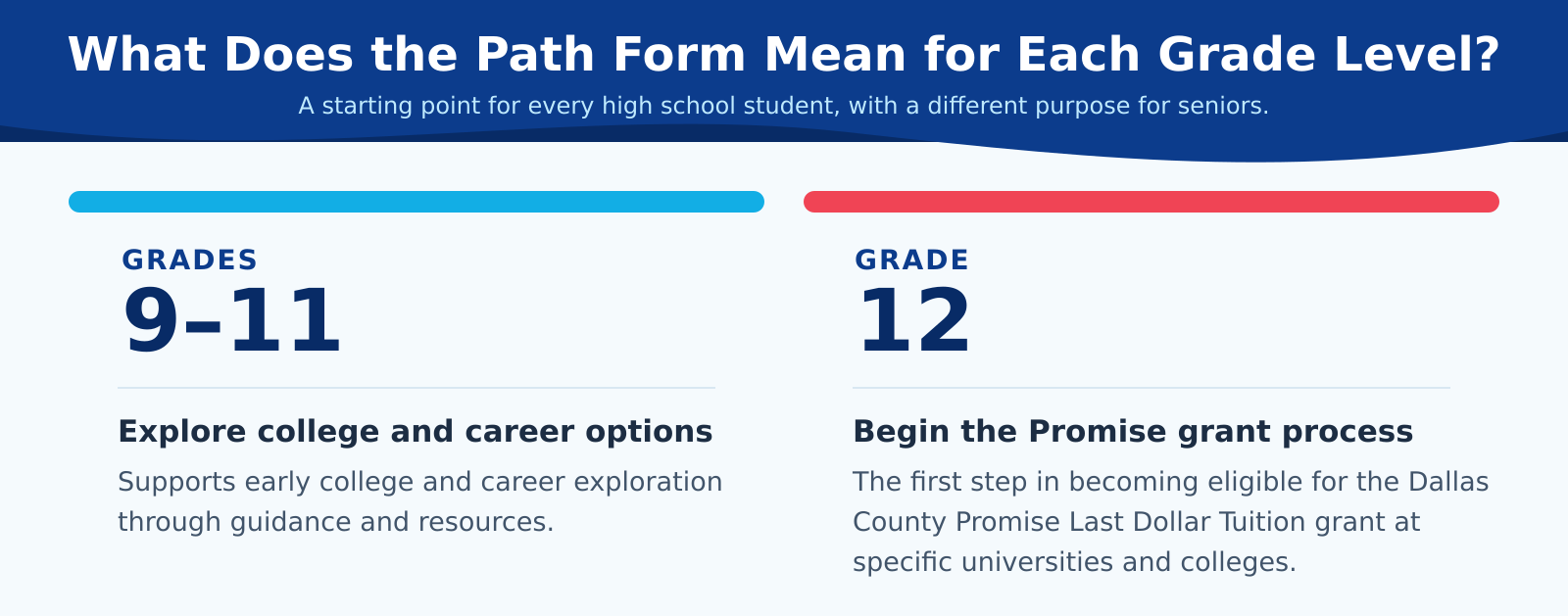
High school students in grades 9–12 can complete the Path Form, but its purpose will differ by grade level. We’ll briefly cover some of the differences for students in grades 9–11 compared to high school seniors below.
Grades 9 Through 11
For high school freshmen, sophomores, and juniors, the Dallas County Promise Path Form is a simple way to learn more about your post-graduation opportunities. It can help provide resources on various schools and potential careers. While it doesn’t provide eligibility for the Last Dollar Tuition grant while in these grades, it can help you get prepared for making your decision on what to do after graduating during senior year.
Grade 12
For high school seniors at a participating school, the Dallas County Promise Path Form is the first step toward becoming eligible for the Dallas County Promise Last Dollar Tuition grant, which helps cover tuition costs at selected partner colleges and universities. Keep in mind that students interested in this grant must also meet any additional eligibility requirements, including submitting a FAFSA or TASFA, along with any other steps required by their chosen school.
What If a Student Is Still Undecided?
It’s understandable for students to be unsure what option is best for them upon graduation, but uncertainty shouldn’t hold them back from accessing resources that can help them decide. Students should fill out the Path Form with the decision they might make today, knowing it isn’t permanent and doesn’t commit them to a specific path after graduation. However, missing out on getting the process started, especially for seniors, may result in missed deadlines and fewer opportunities, so students should be encouraged to fill out the Path Form even if they’re still undecided.
How Families Can Help
Families with uncertain students don’t need to feel helpless, as there are several means of assisting in determining what path to take after graduating:
- Talk with students about their current goals and interests to help them better understand what direction they should take after high school.
- Review different college and career options together, and discuss the various pros and cons of each.
- Help complete the Path Form by gathering any necessary documentation or information.
- Provide reminders on the Path Form deadline to ensure it is submitted on time.
- Regularly check for updates from Dallas County Promise via email or text.
Complete Your Path Form and Take Your First Step
Whether you have a plan on what to do after graduation or are completely undecided on your future, completing the Dallas County Promise Path Form serves as an initial step in determining your future. High school students should feel encouraged to submit their Path Form, with seniors making it a priority to complete it before the initial deadline, to access resources and gain guidance on their path towards their future goals.
